Blog
Loading...

Blog

Christina N. Ortega,
There is still a lot of debate about what artificial intelligence will mean for young people— the opportunities it may create, the risks it may introduce, and how it should be used in school and work. What we know for certain is that AI is already here.
That is why Mission Bit created its first Intro to AI course. We wanted students to understand AI as more than a tool that produces answers. We wanted them to learn how it works, question its outputs, and build projects connected to their own interests and communities.
With support from The Hg Foundation, we launched the pilot in summer 2026. Across two in-person cohorts, 21 students built websites, evaluated AI tools, trained machine-learning models, designed agents, and completed team capstones.
The pilot is part of a three-year partnership supported by a $550,000 grant from The Hg Foundation. The investment supports the design, development, and delivery of the course, along with introductory workshops intended to reach more than 1,000 young people.
The Hg Foundation’s support allowed us to develop the course intentionally. Before launching it, we interviewed students and brought together an advisory group of industry professionals and educators to help shape the curriculum, including expertise from Hg’s Data and AI team. Their input helped us create a course that responded to the questions students already had about AI while introducing the technical knowledge and critical-thinking skills they will need as the technology continues to evolve.
The course introduced students to AI through four connected experiences.
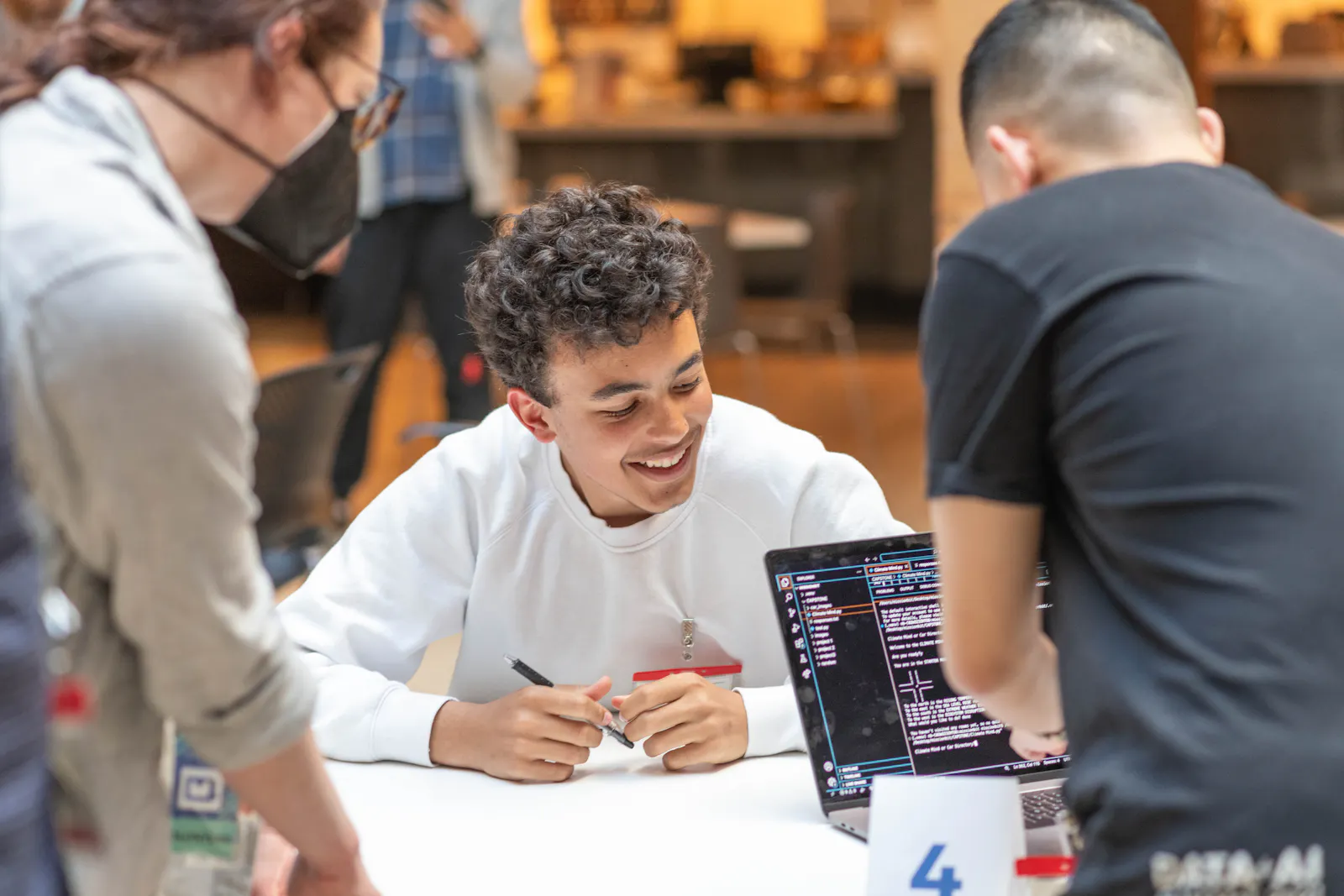
Students began with vibe coding, using natural-language prompts to build and revise websites around problems they cared about. They learned that generating a website was only the beginning: they still needed to test it, evaluate it, and make decisions about the final product.
Next, students investigated how AI is being used in fields such as health care, music, law, and agriculture. They researched professional standards and practiced identifying errors and hallucinations instead of accepting every output automatically.
Students then looked more closely at what happens behind an AI interface. They explored training data, tokenization, neural networks, computer vision, bias, models, and agents. They also trained image classifiers and built websites that put those models to use.
For the final capstone, student teams identified a real need, designed a response, built a prototype, and presented their work. The strongest projects began with something a student already understood or cared about.
Katherine started with an AI travel planner inspired by watching her mother organize a family trip to Japan. She later trained a waste-sorting model, modified AI-generated code, and helped create a database-backed platform that matched prospective adopters with compatible pets.
“Before this class, when I thought of AI, I would just think of ChatGPT,” Katherine said. “Now I’ve learned so many more things you can do with AI besides just asking questions.”
Carolina entered without coding experience. As someone who fosters cats, she used animal adoption as the inspiration for her first project and later returned to it for her team’s capstone. By the end of the course, she could edit code, customize a website, and decide which AI-generated features the project actually needed.
“Before this class, I didn’t know anything about code,” Carolina said. “I’m proud that I know how to build and change things now.”
Kevin began the course associating AI primarily with academic cheating. As he prepared for college, his projects explored questions related to dorm design, studying, and financial independence. His capstone team designed a platform intended to help young adults establish savings goals and reduce impulsive spending.
“I no longer see AI as a cheating tool. I see it more as an assistant,” Kevin said. “If it’s in the wrong hands, it can be used to cheat, but that isn’t the only way people use it.”
As the course progressed, instructors saw students working more independently and carrying knowledge from earlier units into new projects. By the capstone, students were combining skills and adding features beyond the course requirements.
Students also raised thoughtful questions about bias, consent, representative data, job displacement, hallucinations, and responsible use. Their engagement reinforced the importance of teaching technical skills and responsible decision-making together.
The first pilot gave Mission Bit a strong foundation for future versions of Intro to AI. We will continue listening to students and instructors, refining the course, and expanding access through related workshops.
Our focus is getting these skills to the students who need them most before the gap in AI education grows as wide as the digital divide. Students should have the opportunity to understand the technology shaping their lives and to see themselves as people who can question, direct, and build with it.
We are grateful to The Hg Foundation for supporting the development and growth of Mission Bit’s AI education programming. Together, we are helping more young people develop the knowledge and confidence to participate in an increasingly AI-shaped world.
Christina N. Ortega